Creating a mobile solution for New Yorkers to get more directly involved in their local government and community through NYC: Now You Choose.
NYC: Now You Choose is a platform that encourages citizens of New York City to get directly involved in the annual NYC Participatory Budgeting. I had the opportunity to work on this conceptual school project with other fellow designers to create a mobile application that allows users easier access information about the local government.

The Overview
Citizens are always being affected by changes in policy, however big or small. Yet it has been always difficult to understand these complex policies or even receive updates to make informed decisions, resulting in a community feeling less connected with their local government. New York City has been making effort to overcome this gap with the Participatory Budgeting Project, which allows local residents to vote and make informed decision on how this allotted budget will be spent within their community.

Impact
-Streamlined information and access tracking on government projects.
-Allow users to propose projects directly on platform by using structured proposal template.
-Allow users make informed decisions and votes.
Role
User Research, User Interviews, Concepting, Wireframing, Prototyping
Timeline
3 Sprints
The Challenge
Our challenge was to design a better experience for citizens who wanted to or needed access information about their local government and its services. This included taking three main points into account that the government should be transparent, participatory, and collaborative.
The Approach
The topic of government was broad and still unfamiliar for most of us, so we knew we needed to do extensive research to see what was out there and how easy it was to understand the information or data we found. It was important to approach every step of this process with clear key objectives to help direct ourselves since we were dealing with a lot of ambiguity. This would eventually help us narrow down questions to ask for our user interviews and the main problem statement.
Early Insights
Throughout our domain research, we decided on these starting assumptions.
-
There's an overwhelming amount of information scattered across different websites: budget data is hard to read and not streamlined
-
Most websites are outdated
-
Finding crucial information is difficult and unintuitive: ex. finding the right contact number
-
Most government websites touched on these common points: budget, jobs, and contacting government officials
Deeper Insights
To get a sense of the bigger picture, we sourced 9 interviews with experts and users participants who each worked in different departments and agencies in New York City. By doing so, we were able to see find common painpoints of the average civilian or government employee. Based on mostly open-ended questions and stories of their last experience with dealing with government services, we found the key insights below:

Lack of Awareness- People don’t know they have a say in local government laws and budget allocation. They’re passive or disinterested.

Scattered Information- The information is there, but they don’t know where to look or cannot find the answer easily. Information is not readily accessible.

Not Citizen Friendly- Public feels as if these sites are not made for them. They can’t understand the information and even if they see it, they don’t know how it impacts them.

No Knowledge on Budget- People are wondering how their tax dollars are being spent.

Government Misperception- Most users and even government workers have a negative outlook towards the government.
Views on the Government
One of our questions that helped us design our product was asking how the participant might describe the government in which the users answered with the following words below:
-
Slow
-
Unresponsive
-
Bureaucratic
-
Hard to Navigate
-
Out-of-date
-
Inconsistent
-
Unorganized
Meet Our User
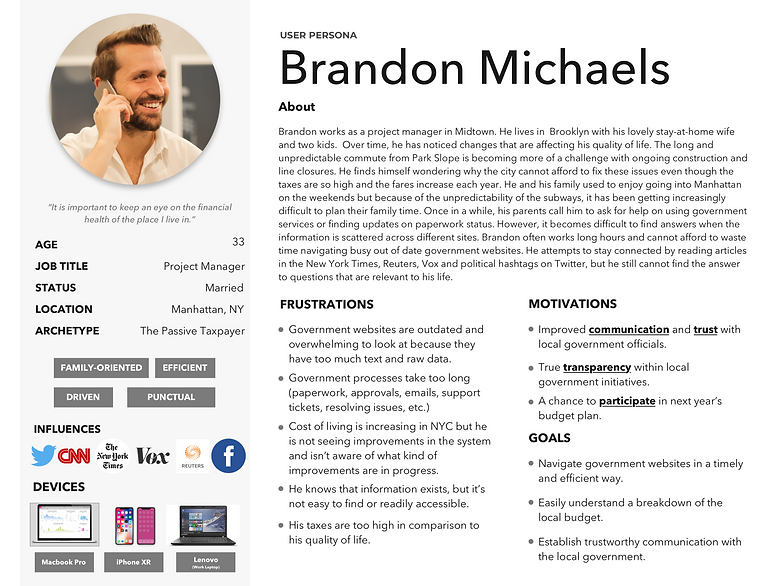
Based on the research and interview results and careful analysis, we were able to identify our persona, Brandon. We based our persona on an average family man and taxpayer in New York City because we realized that people who had a family and was settled were more interested in where their money was going into and how budgets would affect their quality of life.
End-to-end Visualization
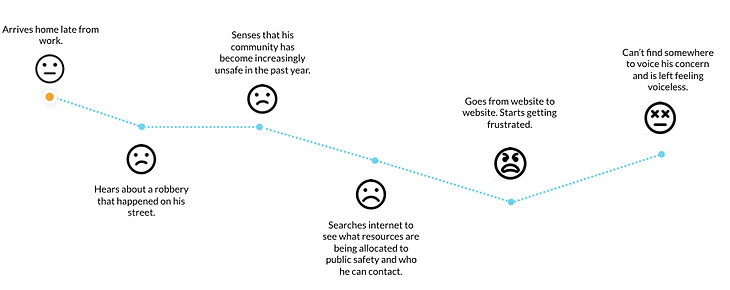
Using the journey mapping technique, we were able to visualize Brandon's end to end experience and focus on particular painpoints and opportunities that helped aim our design at.
Reframing the Problem
Not only did the user persona and journey help visualize the user needs and ideal experience, but it also helped continuously better synthesize the research results to understand the "Why" of users needs. As a result, we reframed the problem like below:
The politically unengaged New Yorker needs a direct way to voice their informed opinion on local budget spending in order to harness their power as a stakeholder and improve current conditions in their community/neighborhood.
Aha Moment!
Up until now our user need was to just access the government budget information in a more intuitive way because the information available online was disorganized, however we were missing out on the user's real needs and motivation to access this budget data. After this our cloud of ambiguity was clearing up.
Ideation Phase
For our concepts, our team time-boxed ourselves to do some rapid sketching on paper. We came up with four divergent concepts to test with users as shown below:
-
Stream budget meetings and post questions to participate on-the-go
-
Education and participation app that allows users to propose projects and learn about budget through successful projects and graphs
-
Messaging app within community, which allows residents to update each other on happenings and meetings in their neighborhood
-
Search project by area and "invest" in project with virtual coins.


Takeaways
From these interviews, we gathered that:
-
Education about the budget is crucial in order to get involved in the local government
-
Users value the ability to participate and voice their opinions
-
They want to see what was happening in their area
The Re-evaluation
While we had the most positive feedback on the Education and Project by Location concepts, we had to re-evaluate the concepts due to the time constraint we were facing. Ultimately the solution would have to be high value but low effort. By using the value/effort matrix we were able to rank the concepts and further brainstorm areas of opportunities. Since we were trying to produce a solution from scratch, technology, information and time constraint was considered when placing these concepts in the matrix.

A New Opportunity,
a New Concept
We went back to the beginning to look at our research and looked further deep into existing sites with concepts around the citizens participation with government's budget initiatives and found one that listed project proposals submitted by local citizens. Using the existing api, we found opportunity to take the NYC Participatory Budgeting onto a mobile platform and implement more refined features and allow citizens to use the product on-the-go.

When implementing new features for the new concept we made sure to keep the three key objectives in mind:
How can we motivate citizens to care?
How can we make this product applicable to the users?
How can we help users achieve results?
Usability Testing
In order to test this new concept we created wireframes using Sketch and through rapid prototyping on Axure and usability feedback, we were able to make quick iterations. Additionally, we tested the workflows by asking participants to complete specific tasks, which 80% of our users were able to complete. Some of the questions that was brought up was, "How is budget related to proposing a project?" and "What is the difference between me voicing on twitter and this app?", which informed us that there was still a lack of information of what NYC Participatory Budgeting was and the impact of how any action on this platform can make an actual difference. Feedbacks like this reminded us that the average person is not familiar with local government initiatives and it was our responsibility to make sure users are fully informed through the product.
Overall, there was positive feedback on the intuitiveness and liked how they were able to share opinions on how they would like to see their tax money being used.


Introducing...
NYC: Now You Choose
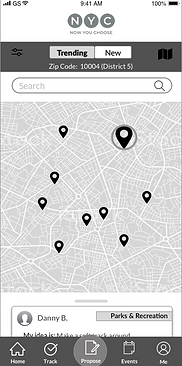
NYC: Now You Choose is a location-based, mobile platform that allows local New York City residents propose and vote on project ideas for the upcoming fiscal year Participatory Budgeting project. It empowers people to make informed decisions and come together as a community to decide how public money should be spent.
An Informative Onboarding
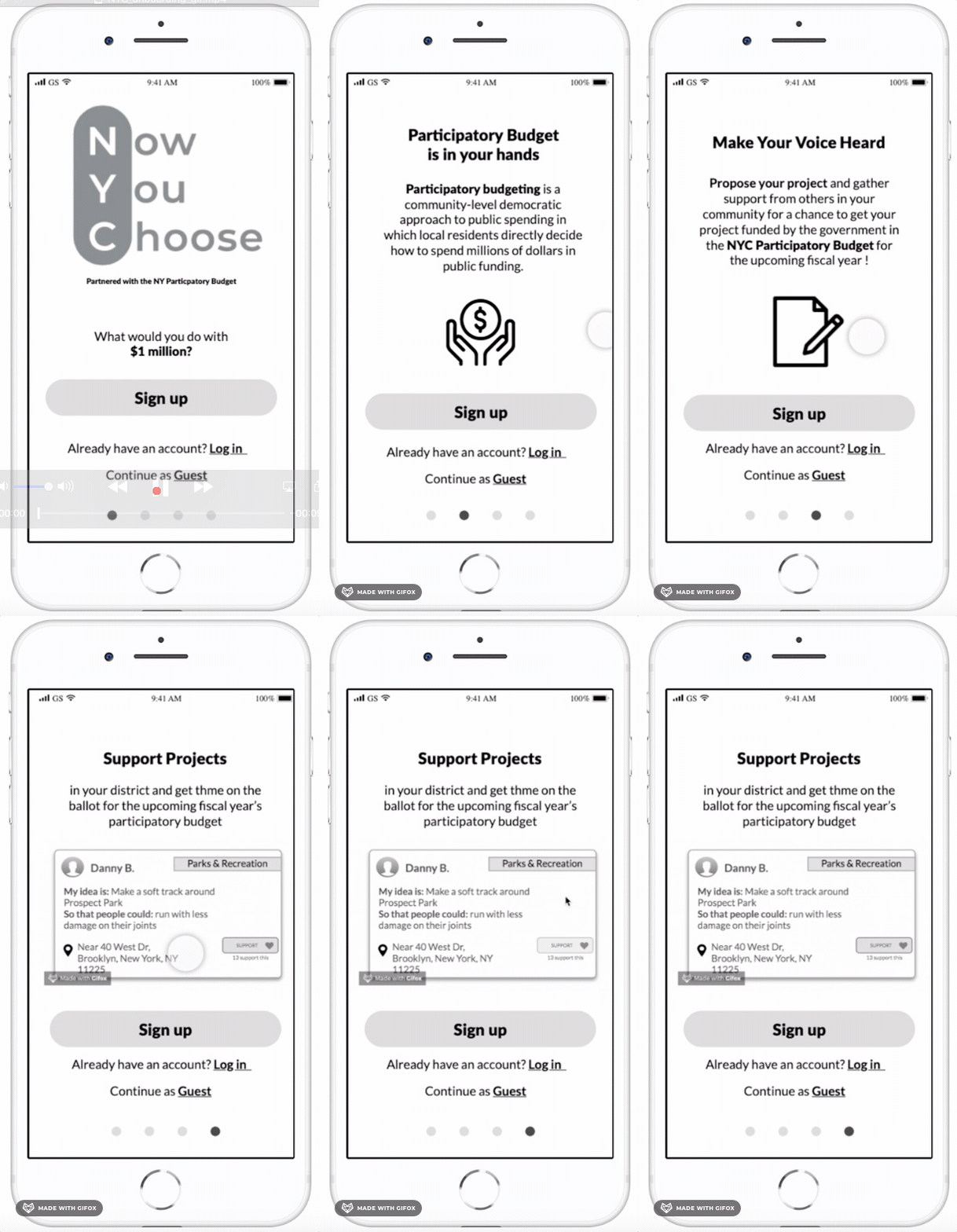
Since our initial testing results showed users lacking information on Participatory Budgeting and how it was applicable to them, we found it crucial to briefly educate users on the government project behind this product, Particpatory Budgeting.
So we iterated to make the onboarding more informative but also motivate users by showing the impact they can make.
Proposing a Project
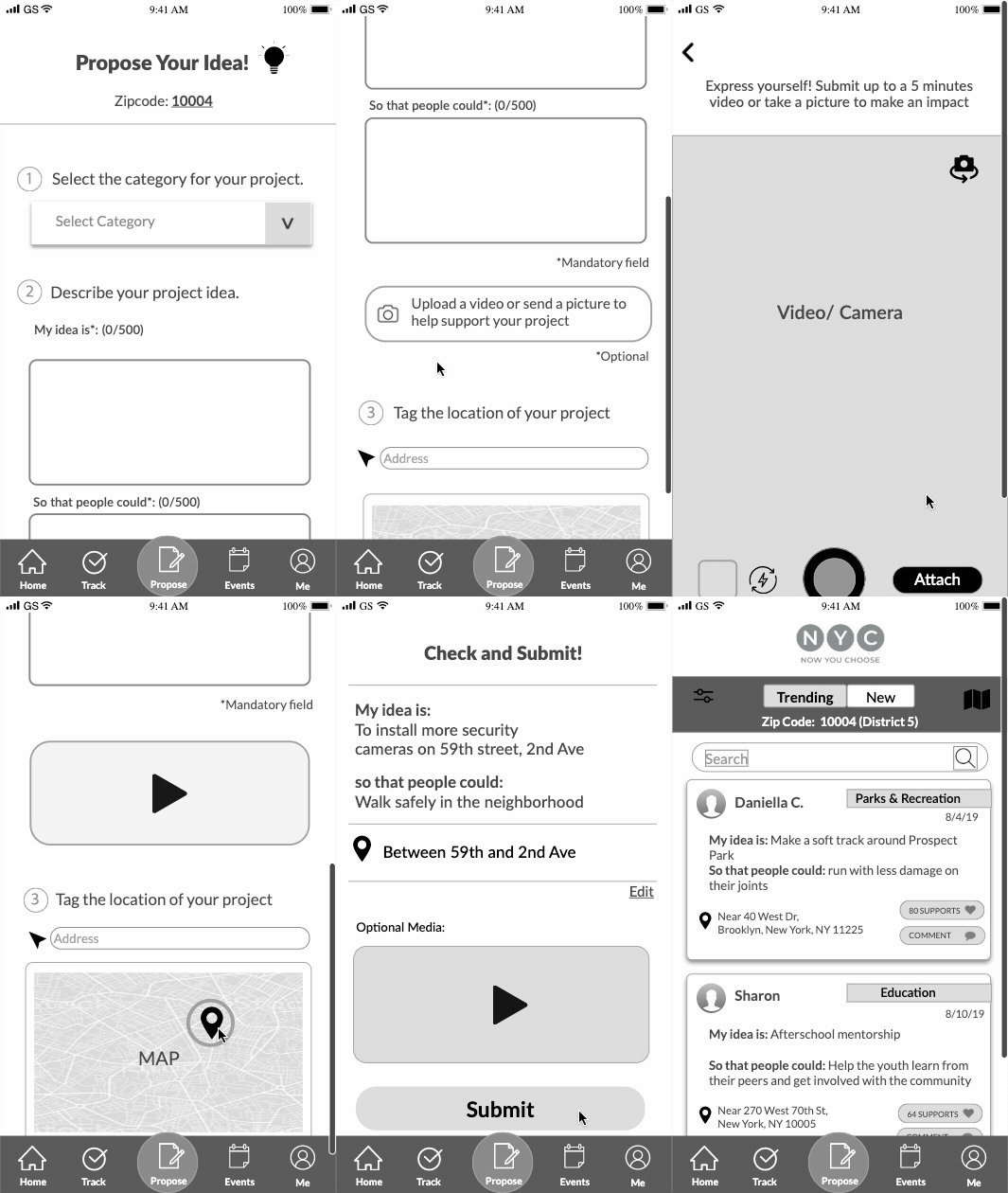
We created a template for project proposals, which is the main feature of the app. Our idea was to make this as simple as possible but also giving enough room self-expression. By starting out the sentence for the users' idea, it puts less pressure on the user to propose their idea but also allows readers to understand different ideas due to the uniformity. We also implemented an optional camera/video feature where users can express their ideas in a less structured way.

Support and Vote for Projects
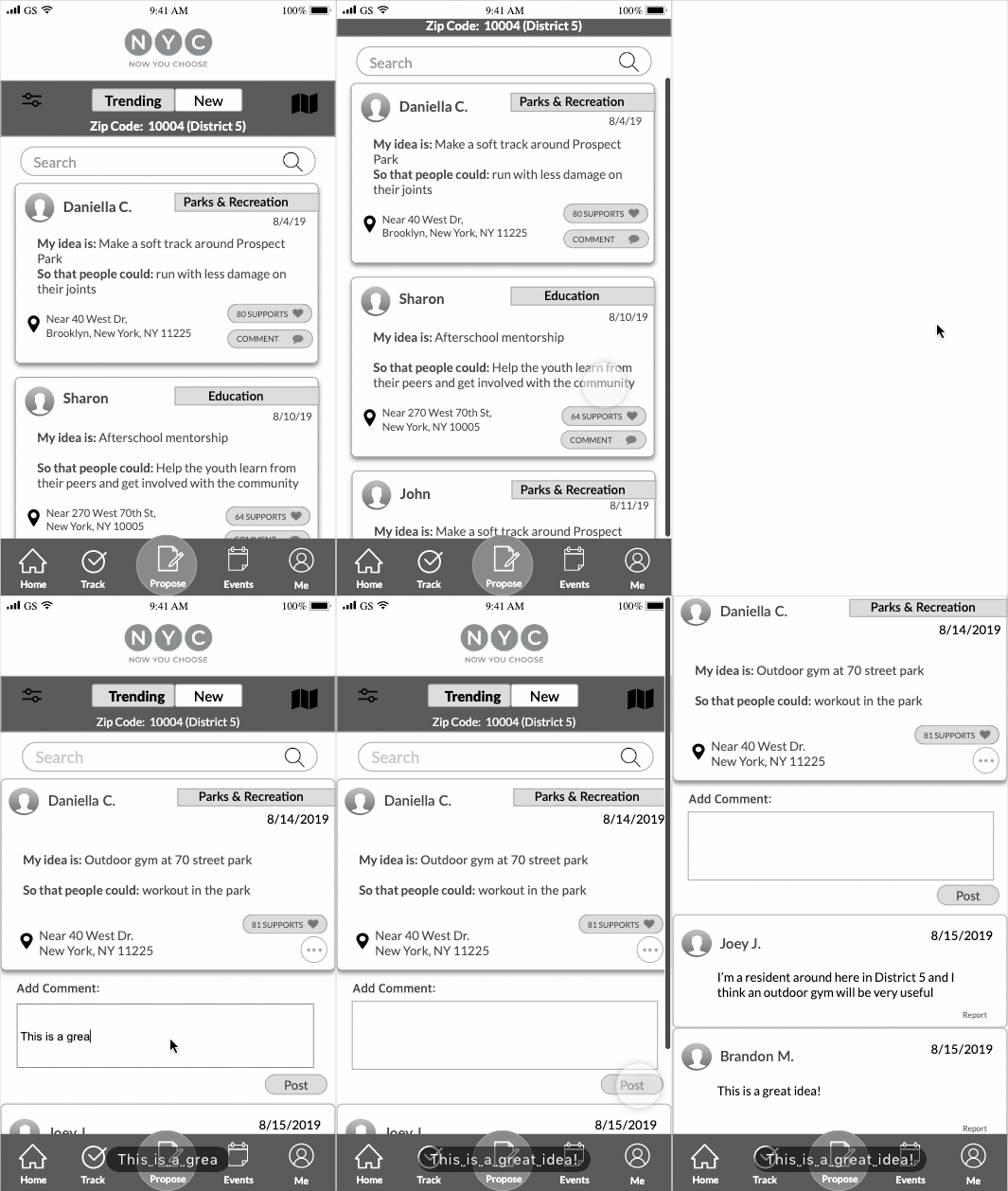
This app was designed for users to get more involved and be able to make an impact. By letting users directly vote and comment for projects, it allows them to harness their power as stakeholders in their community and stay informed on changes that may occur from these results.
Staying In the Know
The Participatory Budgeting is a once a year thing, but it was crucial to keep in mind when designing this platform that changes in the government happen all year round. We kept a calendar of events and meetings based on the user's district so that citizens can still stay involved and keep track on any updates regarding budgets or projects.

What's Next
We would like to further test out our prototype in means of gaining more feedback on features and workflows. Due to the time constraint we could only conduct two rounds of usability testing. Also, we know that we weren't able to incorporate much of the educational content as we had hoped to. In the future we would like to see how we could implement more of the education aspect into the product since it is a significant step into making better informed decisions as a citizen. Lastly, we would like to explore a way to include updates on projects that have been voted to be funded in a way that is simple and intuitive.